CORE RECIPE · 10 MIN READ
Homemade Fermented Cabbage
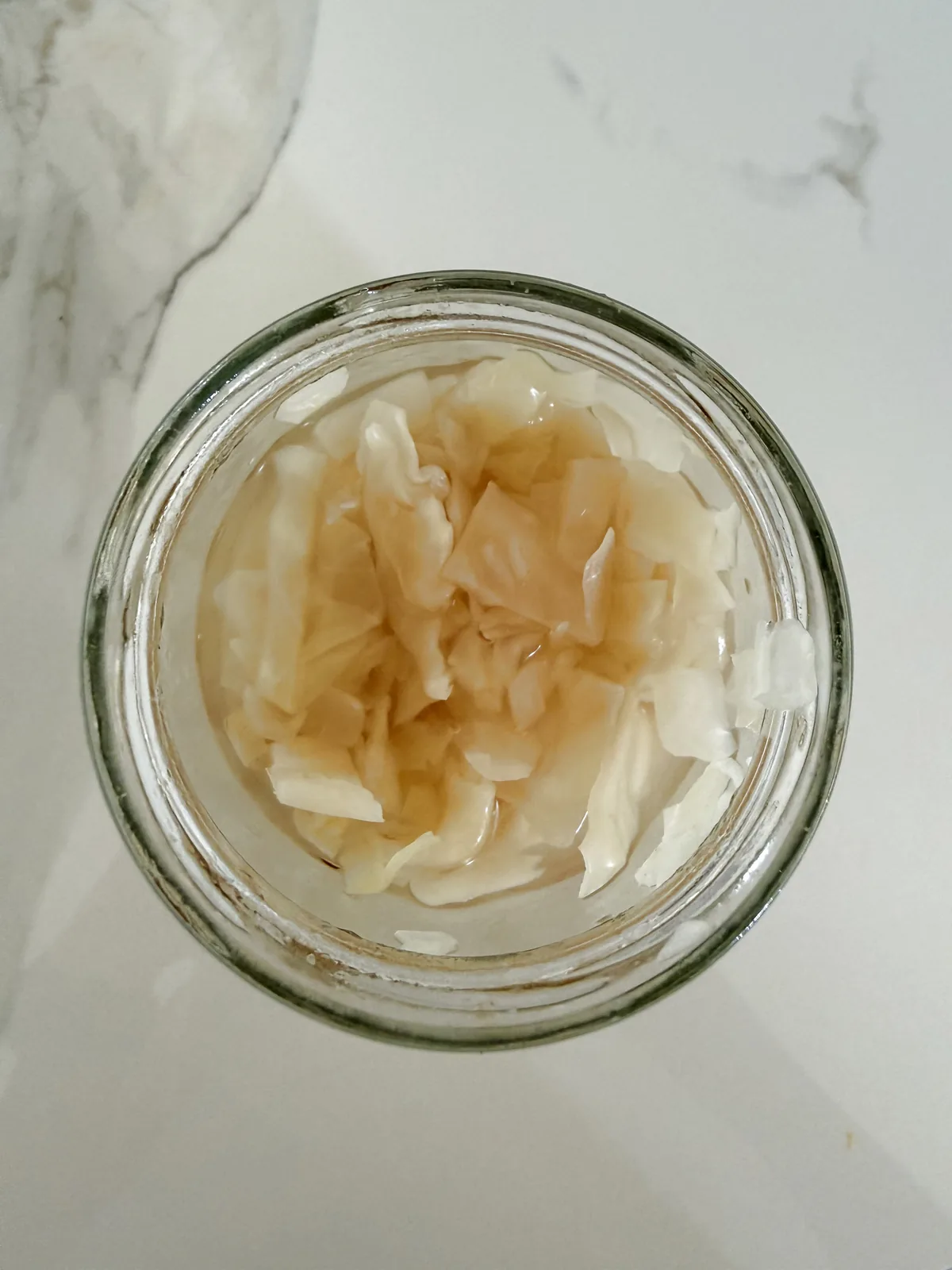
Crisp homemade sauerkraut is made from salted white cabbage, as microorganisms convert some of its naturally occurring sugars into lactic acid, giving it its characteristic aroma and flavour.
 ~1 gNET CARBS
A fermented staple
Cabbage, salt, time and the right temperature
For a reliable result, measure the salt precisely, keep the cabbage beneath the brine throughout and match the temperature to the expected fermentation time.
The recipe at a glance
Recipe details
Shopping list
Ingredients and equipment
Ingredients
Equipment
Step by step
Method
- 1
Prepare a clean workspace
Clean the work surface and utensils thoroughly. Wash the jar, weight and lid in hot water with detergent, rinse well and sterilise the jar according to safe preserving guidance. Wash and dry your hands.
- 2
Prepare the cabbage
Remove damaged outer leaves. Rinse the cabbage, quarter it and remove the core. Weigh exactly 1,000 g trimmed cabbage.
- 3
Slice it thinly
Cut the cabbage into strips ~1.5 mm thick so that it salts, softens and ferments evenly. [1]
- 4
Add the salt
Add all 22 g salt. With very clean hands, squeeze and massage the cabbage for 5–10 minutes until it wilts and releases liquid. Leave it for 10 minutes, then massage it again.
- 5
Pack the jar firmly
Add the cabbage one handful at a time and press each layer down firmly. Pour in all the released liquid and leave ~5 cm headspace.
- 6
Keep it beneath the brine
Weight the cabbage down. Every piece must remain under the liquid. If there is not enough juice, add only enough boiled and cooled brine made with 25 g salt and 950 ml water to cover it. [1]
- 7
Allow gases to escape
Fit an airlock or tighten the lid only enough to let gases escape safely. Place the jar on a tray.
- 8
Ferment at a controlled temperature
Place the jar in a dark location at 21–23°C for 3–4 weeks. At 15–18°C, allow 5–6 weeks. Below 15°C, fermentation may not begin; above 26°C, the likelihood of a soft or spoiled product increases. [1][3]
- 9
Check it regularly
Two or three times a week, check that the cabbage remains completely submerged. Do not shake the jar or use unclean utensils. Bubbles and a fresh, sour aroma are expected.
- 10
Assess readiness and safety
The cabbage is ready when it is pleasantly sour, remains firm and bubbling has subsided. If you see mould or notice a slimy texture or rotten smell, discard the contents without tasting them. [3][4]
- 11
Refrigerate it
Remove the airlock, seal the jar tightly and refrigerate it. Keep the cabbage beneath the brine and always serve it with a clean utensil.
Two ways to serve it
Keto variations
Sauerkraut with sour cream
1 serving · 10 minutes preparation · 20 minutes cooking
- 120 g sauerkraut with liquid
- 30 g ripe tomato
- 10 g onion or shallot
- 40 g full-fat sour cream
- 5 g butter
- 30 ml water, plus more if needed
- 0.2 g black pepper and 0.2 g caraway
- salt only after tasting
Cook the onion in butter for 3–4 minutes. Add the cabbage and caraway and cook for 2 minutes. Add the water, cover and cook for 10–12 minutes. Add the tomato and pepper and cook for another 2 minutes. Remove from the heat; mix the sour cream with one spoonful of hot liquid before stirring it into the cabbage.
~147 kcal | P ~2 g | F ~12 g | total carbs ~9 g | net carbs ~5 g
Quick Greek yoghurt variation
Combine 150 g cold fermented cabbage with 50 g plain full-fat Greek yoghurt and add pepper or caraway if desired. Do not add sour cream, butter, onion or tomato. Stir in the yoghurt just before serving and do not heat it strongly.
~77 kcal | P ~6 g | F ~3 g | total carbs ~8 g | net carbs ~4 g
The role of the ingredients
Why the method works
White cabbage
It provides a crisp plant base, carbohydrates for fermentation and dietary fibre. Microorganisms convert some sugars mainly into organic acids. [2][6]
Salt
It draws out liquid, helps form the brine and inhibits some unwanted microorganisms. It is therefore not optional seasoning. [1][2]
Time and temperature
Submersion limits exposure to air, while temperature affects fermentation speed and texture. [1][3]
Fermented does not automatically mean probiotic
Unpasteurised sauerkraut may contain live microorganisms, but the term probiotic requires identified strains, an adequate amount and a demonstrated benefit. [6][7]
Substitutions and tips
Adjust the flavour, not the safety ratio
- Use a firm, mature and undamaged head of white cabbage.
- You may replace part of the white cabbage with red cabbage; always recalculate the salt from the total weight of trimmed cabbage.
- Add cloves, caraway, bay leaf, paprika, allspice or juniper for flavour, never in place of salt.
- For a less salty flavour, rinse the finished cabbage immediately before eating. Do not reduce the salt during fermentation or dilute the ferment with plain water. [1][3]
- Fermenting cabbage has a long tradition in Ljubljana’s Trnovo and Krakovo districts; the local cabbage trade expanded around 1840. [8]
Good to know
Frequently asked questions
How should I store the prepared dish?
Keep it sealed in the refrigerator and beneath the brine. With clean handling, it can be stored for up to 9 months, but inspect it regularly. Use the sour cream variation within 3–4 days and the yoghurt variation within 24 hours. [3][9]
Can I freeze it?
Yes. For the best quality, use it within 8–12 months. It may be softer after thawing. Do not freeze the sour cream or yoghurt variations. [9][10]
Is this recipe keto?
Yes. A basic serving contains ~4 g total and ~1 g net carbs. Both variations remain below 10 g net carbs.
Can I prepare it in advance?
Yes. The base is intended for larger-quantity preparation. You can cook the sour cream variation in advance, but add the yoghurt just before serving.
How should I reheat the sauerkraut with sour cream?
Reheat it in a small pan over low heat, add one spoonful of water if needed and stir frequently. Do not reheat the yoghurt variation.
Sources, methodology and limitations
The nutrition estimate uses an official entry for finished sauerkraut as the closest comparable profile. Actual values may vary.
- National Center for Home Food Preservation — Sauerkraut
- Colorado State University Extension — Understanding and Making Sauerkraut
- Penn State Extension — Fermentation
- Oregon State University Extension — Problems and Solutions
- USDA FoodData Central — FDC 169279
- NIH Office of Dietary Supplements — Probiotics
- ISAPP consensus statement
- ZRC SAZU — history of cabbage growing in Trnovo
- University of Minnesota Extension — Fermentation
- NCHFP — Frozen Food Storage
Continue with the staples
Related recipes
Save recipe
Homemade Fermented Cabbage
- 1,000 g white cabbage
- 22 g pickling salt
- a jar, weight and safe venting lid
Slice the cabbage thinly, salt it precisely, massage it and pack it firmly into a clean jar. Keep it beneath the brine and ferment at a controlled temperature.
This recipe provides general information and does not replace individual medical or nutritional advice.
THE UNWIND COMMUNITY
Cook with The Unwind
Follow along for practical keto recipes, meal-planning ideas and calm support for everyday nourishment.
Join